

EB-1A Membership Criterion Explained: How to Prove Extraordinary Ability and Strengthen Your Immigration Case

1. Introduction to EB-1A and the Membership Criterion
The EB-1A (Extraordinary Ability) immigrant visa category is reserved for individuals at the top of their field—those who have achieved sustained national or international acclaim in sciences, arts, education, business, or athletics. To qualify, a petitioner typically must show either:
- A major, internationally recognized award (e.g., Nobel Prize), or
- Evidence satisfying at least three out of the ten criteria in 8 CFR § 204.5(h)(3).
One of these ten criteria addresses membership in associations that require outstanding achievements of their members. The government scrutinizes this because many professional memberships are merely fee-based, open to people holding standard credentials, or not truly reflective of “extraordinary ability.”
However, membership can be used beyond that specific criterion as well. Many applicants overlook the fact that being active in committees, presenting at organizational events, or holding leadership positions within a prestigious group can bolster other EB-1A criteria, such as leading or critical role in distinguished organizations, original contributions, or judging the work of others.
This blog explores both dimensions:
- How to use membership to meet the strict membership criterion.
- How to leverage membership activities—like committee work, presenting at conferences, or leading chapters—to support other EB-1A criteria.
2. Why Membership Often Faces High Scrutiny
Membership-based claims can appear in nearly every EB-1A petition, but USCIS officers and the AAO (Administrative Appeals Office) see countless professional affiliations.
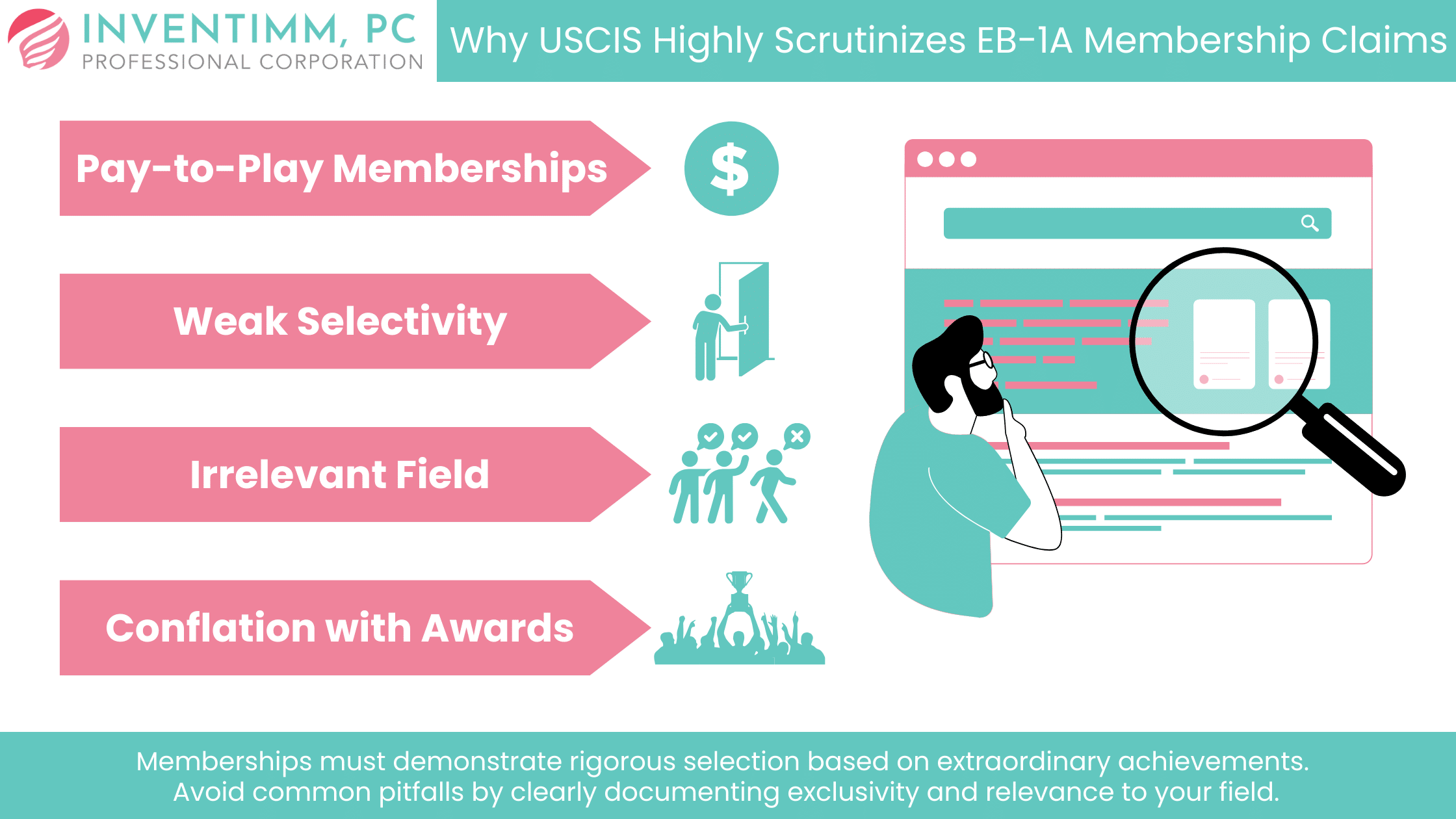
The reality is that many memberships do not evidence extraordinary distinction, because:
- Pay-to-play: Some organizations allow any applicant who pays dues to join.
- Basic Eligibility: Others accept all individuals who have a certain degree or job title, which is far from “outstanding achievements.”
- Over-claimed: Many applicants incorrectly assume that well-known trade groups automatically qualify.
- Lack of Evidence: Even potentially valid memberships sometimes fail due to inadequate documentation showing selectivity or prestige.
To overcome this skepticism, petitioners must prove that recognized experts in the field assessed their achievements before granting membership, and that the criteria are more rigorous than simply paying a fee or checking a few boxes.
3. Deep Dive: Regulatory Language and AAO Guidance
8 CFR § 204.5(h)(3)(ii) states that the petitioner may submit:
Evidence of membership in associations in the field for which classification is sought, which require outstanding achievements of their members, as judged by recognized national or international experts in their disciplines or fields.
Key takeaways:
- The association must be related to the applicant’s field.
- The organization must require “outstanding achievements” for acceptance.
- This requirement should be enforced or judged by recognized experts (i.e., peer review, competitive selection, or similarly robust processes).
AAO decisions reinforce that the membership criterion is about exclusivity. A basic membership in a large professional body—where nearly anyone with minimal credentials can join—does not satisfy this standard.
4. Common Government Pushbacks (With Examples)
When USCIS or AAO issues Requests for Evidence (RFEs) or denies petitions based on membership, they often cite one or more of the following reasons:
4.1. Pay-to-Play or Fee-Based Memberships
Issue: If the membership is available to anyone who pays an annual fee, it indicates a lack of rigorous achievement-based selection.
Example: An “International Network of Business Professionals” that sends mass invitations to prospective members for a paid membership.
What to Provide: Show the exact admission criteria, highlight how the petitioner had to submit evidence of extraordinary achievements, and confirm that recognized experts reviewed that evidence.
4.2. Weak or Non-Competitive Selectivity
Issue: Even if there is a membership process, it may be too general or based on easily met criteria (e.g., having a bachelor’s degree or two years of experience).
Example: A science association that requires only “a minimum of three years’ professional experience and a reference letter.” That threshold might not reflect outstanding ability.
What to Provide: Demonstrate genuine exclusivity—for instance, only 5% of applicants gain admission, or membership is limited to individuals who have, e.g., published extensively in top journals or received national honors.
4.3. Disconnect Between Membership and Field of Expertise
Issue: The membership is in a different or unrelated field, or the organization is so broad (covering multiple unrelated disciplines) that membership does not necessarily reflect achievements in the petitioner’s specific field.
Example: A top AI researcher claiming membership in a general academic society that admits all STEM professionals with minimal scrutiny—no direct link to top-tier AI distinction.
What to Provide: Articulate how the association is directly connected to the field of endeavor, and how membership criteria specifically evaluate achievements in that field.
4.4. Conflating Membership With Awards
Issue: A petitioner claims an honorary recognition or “Hall of Fame” induction as “membership.” The AAO may find it is not an ongoing association but rather a single-time award and thus does not fit the membership criterion.
Example: Being inducted into a “Who’s Who” listing can be an honor (though often pay-to-play), but it may not meet the membership requirement if it’s not an ongoing, selective organization.
What to Provide: Clearly distinguish if something is truly an award (one-time recognition) or a membership (ongoing with set requirements). If it’s an award, consider using the “Lesser Nationally or Internationally Recognized Awards” criterion.
5. Establishing Prestige and Selectivity: Core Principles
To successfully use membership as evidence for EB-1A, you must show:
- High-Level Prestige
- The organization is nationally or internationally recognized as prominent in your field.
- It has a reputation for being made up of accomplished individuals who have significantly advanced the discipline.
- Stringent Selection
- A panel or committee of experts reviews applicants.
- Admission is only granted if the applicant’s contributions or achievements meet exacting standards (e.g., major publications, patents, recognized awards).
- Tight Relevance
- The membership is specifically tied to the field in which you claim extraordinary ability.
- The criteria for membership revolve around that field’s benchmarks (e.g., recognized breakthroughs in biomedical engineering if you are a biomedical engineer).
- Supporting Evidence
- Bylaws, selection procedures, and official membership documentation.
- Affidavits or letters from membership committee officials or recognized authorities.
- Statistical data: acceptance rates, the achievements of typical members, historical rosters.
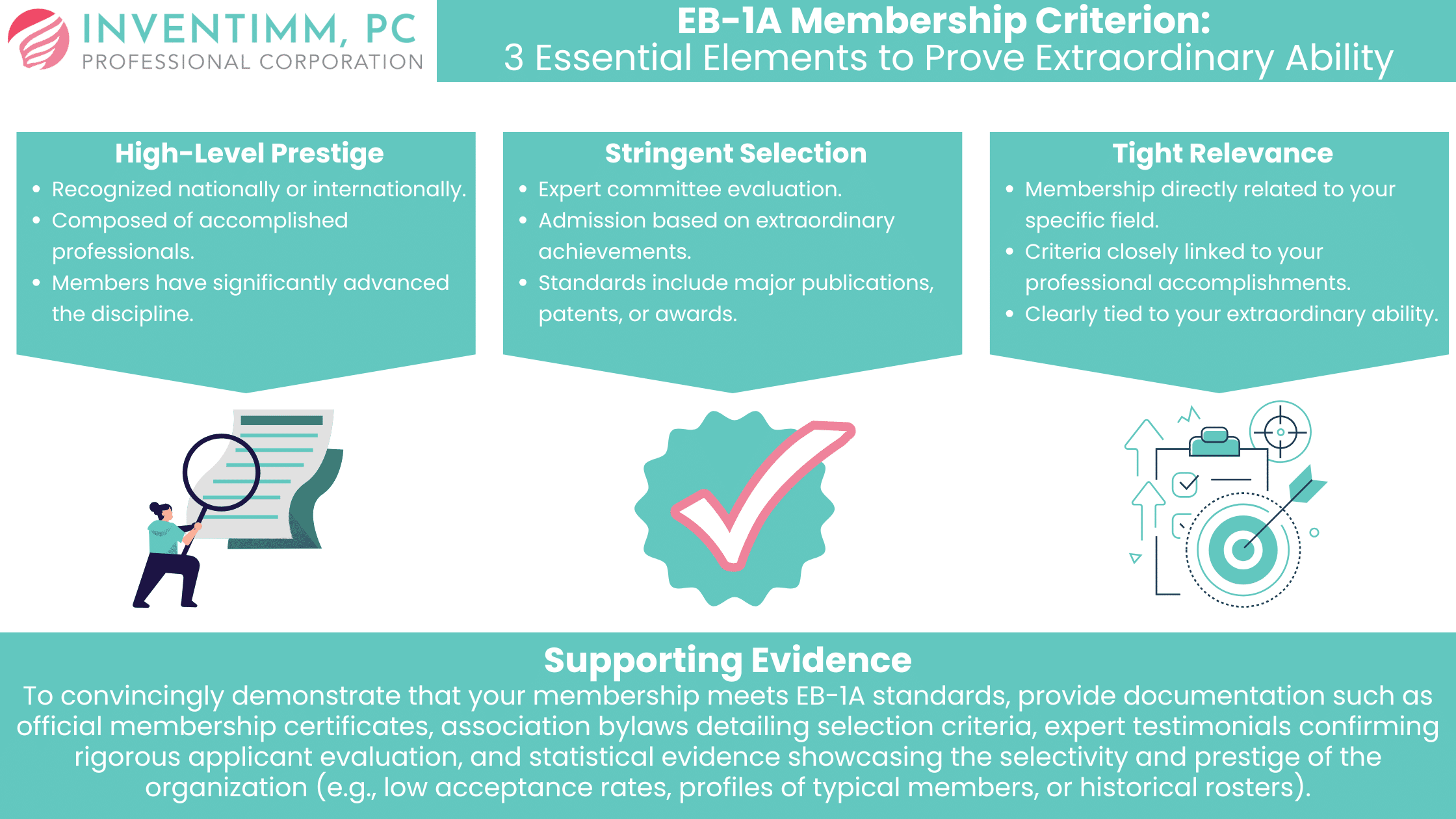
Meeting these standards helps overcome the frequent skepticism that membership alone is rarely conclusive proof of extraordinary ability.
6. Documenting Your Membership: Strategies and Examples
- Official Membership Certificate or Letter
Always include your certificate of acceptance or an official letter confirming your membership. This establishes basic authenticity. - Bylaws or Membership Criteria
Where possible, gather the organization’s published criteria—often available in bylaws or on the group’s official website. If these are in a foreign language, provide certified translations. - Letters from Membership Committee/Organization Leaders
Strong letters from the individuals responsible for your acceptance can verify that they reviewed your credentials and recognized your unique accomplishments. - Comparative or Statistical Evidence
If relevant, show how few people get admitted, or if membership is limited to those with, for example, “X major publications” or “Ph.D. plus an extensive record of innovation.” Hard data is persuasive.
Realistic Example:
- You are a data scientist recognized for pioneering work in natural language processing. You hold Fellow status in the Association for Computational Linguistics (ACL). You can provide:
- The official letter conferring your Fellow title.
- Excerpts from the ACL website detailing that Fellow status is awarded to individuals “who have made extraordinary contributions to the field of computational linguistics.”
- A statement from the Fellow Selection Committee, explaining that only about 0.25% of members each year are selected and referencing your multiple groundbreaking papers as the reason for acceptance.
This type of evidence package can be compelling to a USCIS officer.
7. Leveraging Membership for Other EB-1A Criteria
Even if your membership cannot stand alone under the membership criterion, the fact that you are active in committees, regularly present at conferences, or lead certain organizational initiatives can help satisfy or supplement other EB-1A criteria, such as:
7.1. Demonstrating a Leading or Critical Role
One of the EB-1A criteria is to show that you have played a leading or critical role for organizations or establishments with a distinguished reputation. If you hold a leadership position within a highly regarded association—e.g., you chair a committee, direct a task force, or serve on the board—that might qualify. Evidence might include:
- Documents from the association naming you as the Chair of the Education Committee or head of a Special Interest Group.
- Meeting agendas, minutes, or official statements demonstrating your leadership responsibilities.
- Testimonials from other members confirming that your role shaped the organization’s direction or key initiatives.
By demonstrating that you contribute at a decision-making or critical level, you bolster your argument for extraordinary ability through leadership accomplishments.
7.2. Showcasing Original Contributions or Acclaim
Membership can also be used to show how the field has recognized your contributions. For instance:
- If you’re frequently invited by the association to give keynote speeches, moderate panels, or conduct training sessions for younger professionals, it may help prove that your work is widely respected.
- Committee work within the association might involve developing new guidelines or best practices that the entire membership adopts—evidence of an original contribution of major significance (another EB-1A criterion).
In your petition, you can connect these membership-related activities to your claim of having made substantial, original contributions in the field.
7.3. Highlighting Judging/Peer Review Opportunities
Another EB-1A criterion involves the petitioner’s participation as a judge or reviewer of the work of others in the field. Membership in a recognized association can often lead to:
- Serving on abstract review committees for the association’s annual conference.
- Reviewing submissions for the association’s peer-reviewed journal.
- Being appointed to an awards committee selecting top researchers or innovators.
These roles demonstrate that your expertise is valued enough for you to serve as a gatekeeper in the field—an important hallmark of “extraordinary ability.”
8. Real-World (Hypothetical) AAO Examples
Although most AAO decisions are non-precedent, they still offer guidance on how USCIS and the AAO analyze membership. Below are hypothetical summaries reflecting common themes:
8.1. Matter of A—Fee-Based Society
The petitioner claimed membership in the “World Leaders in Marketing” organization. USCIS found that:
- The membership was primarily fee-based.
- No tangible, clearly stated requirements for “outstanding achievements.”
- No evidence of a recognized expert committee evaluating the petitioner’s credentials.
Result: Denied for failing to show that membership was selective or indicative of extraordinary marketing achievements.
8.2. Matter of B—Broad Field, Limited Evidence
The petitioner, a top biochemist, claimed membership in a general “National Science Association.” The association’s website indicated it accepted all scientists with a bachelor’s degree. The petitioner’s membership was therefore not probative of extraordinary ability.
However, the petitioner also submitted letters showing that within this association, they served as an Executive Committee Member for the specialized Biochemistry Chapter, which had significant selection criteria for its leadership. The AAO found that while the basic membership did not meet the membership criterion, the leadership position evidence contributed favorably toward the leading or critical role criterion.
Result: Partially Favorable – The membership itself did not satisfy the “membership in associations requiring outstanding achievements” criterion, but the executive committee role weighed positively for “leading or critical role.”
8.3. Matter of C—Committee Involvement and Leadership
In this hypothetical, the petitioner was a computer graphics engineer who became a Senior Member of the “Digital Artists Alliance.” The bylaws stated that Senior Member status required:
- At least 10 recognized publications in top venues.
- Two letters from Fellows attesting to the significance of contributions.
- Approval by a selection board consisting of established leaders in digital art.
The AAO noted:
- The membership selection process was highly competitive and peer-reviewed.
- The association was nationally recognized in the digital arts community.
- The petitioner also chaired the Education Outreach Committee, shaping new professional standards.
Result: Approved – This membership satisfied the membership criterion. Additionally, the committee leadership helped demonstrate both original contributions and a leading/critical role in a distinguished organization.
9. Tying Membership into Your Field: Practical Tips
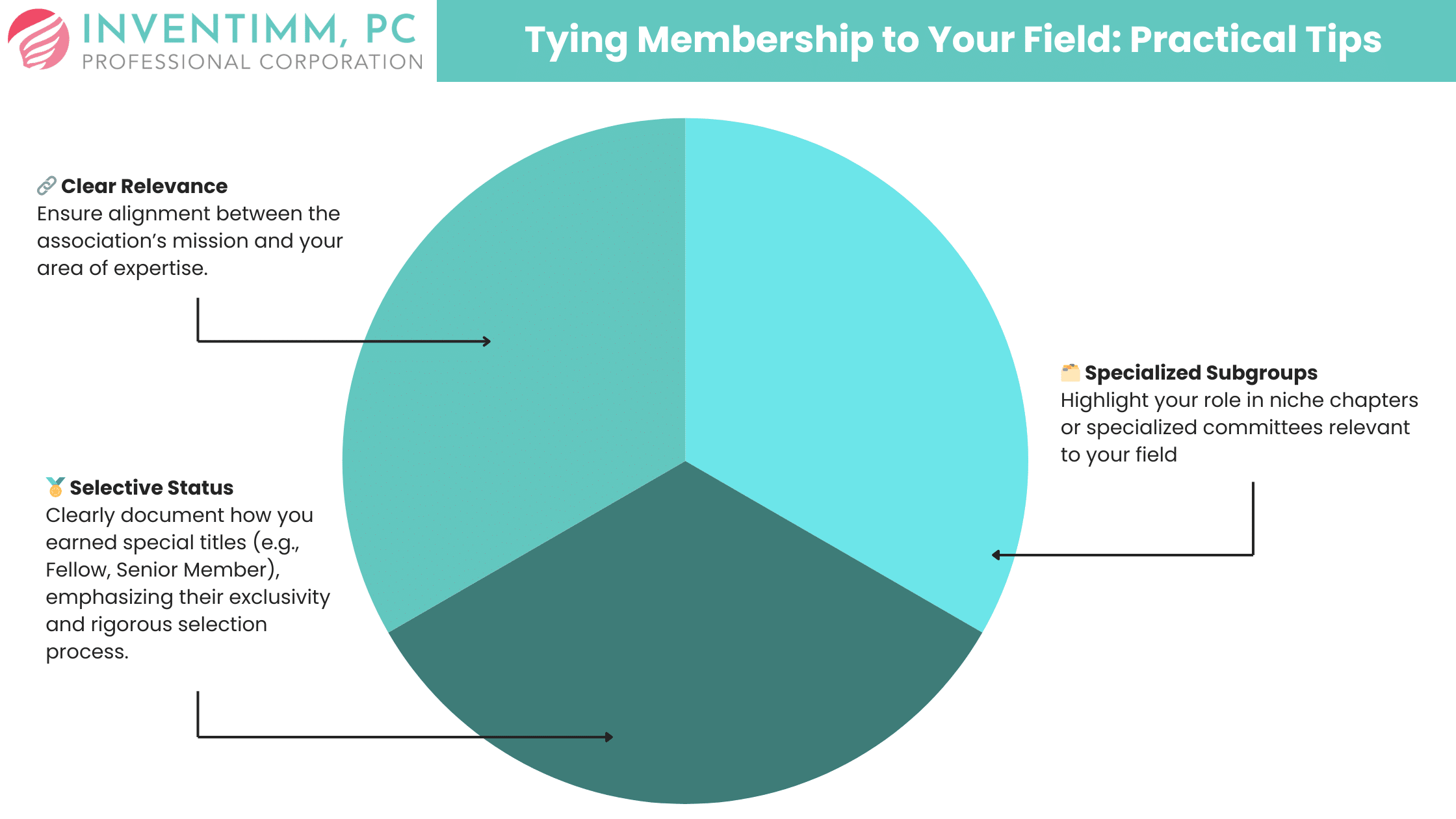
- Highlight the Relevance: Make sure the organization’s mission and scope align with your area of expertise. Provide a succinct statement in your cover letter or petition explaining how the group is recognized as an authority in your niche.
- Explain Any Subgroups: If the organization covers broad disciplines (like general engineering), emphasize your membership in a specialized branch or chapter specifically for your field (e.g., microfluidics, AI, etc.).
- Provide Tangible Evidence of Distinction: If you hold a special status—Fellow, Senior Member, Board Member—clarify exactly how you earned it and why it’s selective.
10. Selecting the Right Organizations for EB-1A
No official “approved list” exists, but certain prestigious bodies are commonly recognized for their rigor:
- National Academies (e.g., National Academy of Sciences, National Academy of Medicine): Extremely selective, typically by invitation or election.
- Fellowships of Elite Societies (e.g., IEEE Fellow, ACM Fellow, APS Fellow): Usually require nomination, peer review, and evidence of substantial contributions.
- Distinguished Membership Tiers in specific professional associations: Senior Member or Fellow status in recognized, respected organizations in a field.
If you are a member of a less-famous but still exclusive association—especially outside the U.S.—showing bylaws, selection rates, and recognized expert committees can still establish its prestige.
11. Common Pitfalls and How to Avoid Them
- Overstating Prestige: Claiming an organization is “elite” when it actually accepts most applicants who meet minimal criteria can damage credibility.
- Failing to Document Criteria: If you do not provide official or objective evidence of membership requirements, USCIS may assume it’s non-selective.
- Ignoring English Translations: If critical bylaws or membership rules are in another language, certified translations are a must.
- Conflating an Award with a Membership: Clarify whether you hold an ongoing membership or simply received a one-time honor.
12. Secondary Evidence: Strengthening Your Case Beyond the Basics
Sometimes an association’s official documents are not publicly posted, or membership criteria are ambiguous. In these instances, consider providing:
- Affidavits from recognized experts (preferably not family or close colleagues) who can confirm the association’s exclusivity.
- Testimonial letters from leadership or longtime members explaining the acceptance process.
- Media Coverage: Articles or press releases that describe the group as an exclusive body, listing members with notable achievements.
- Historical Significance: If the association’s membership historically includes Nobel Prize laureates, well-known innovators, or similarly recognized figures, referencing this can highlight its prestige.
Pro Tip: While secondary evidence can be persuasive, try to corroborate it with at least some primary evidence (like membership rules or official guidelines) to avoid the appearance of hearsay.
13. Membership in Action: Showcasing Thought Leadership and Visibility
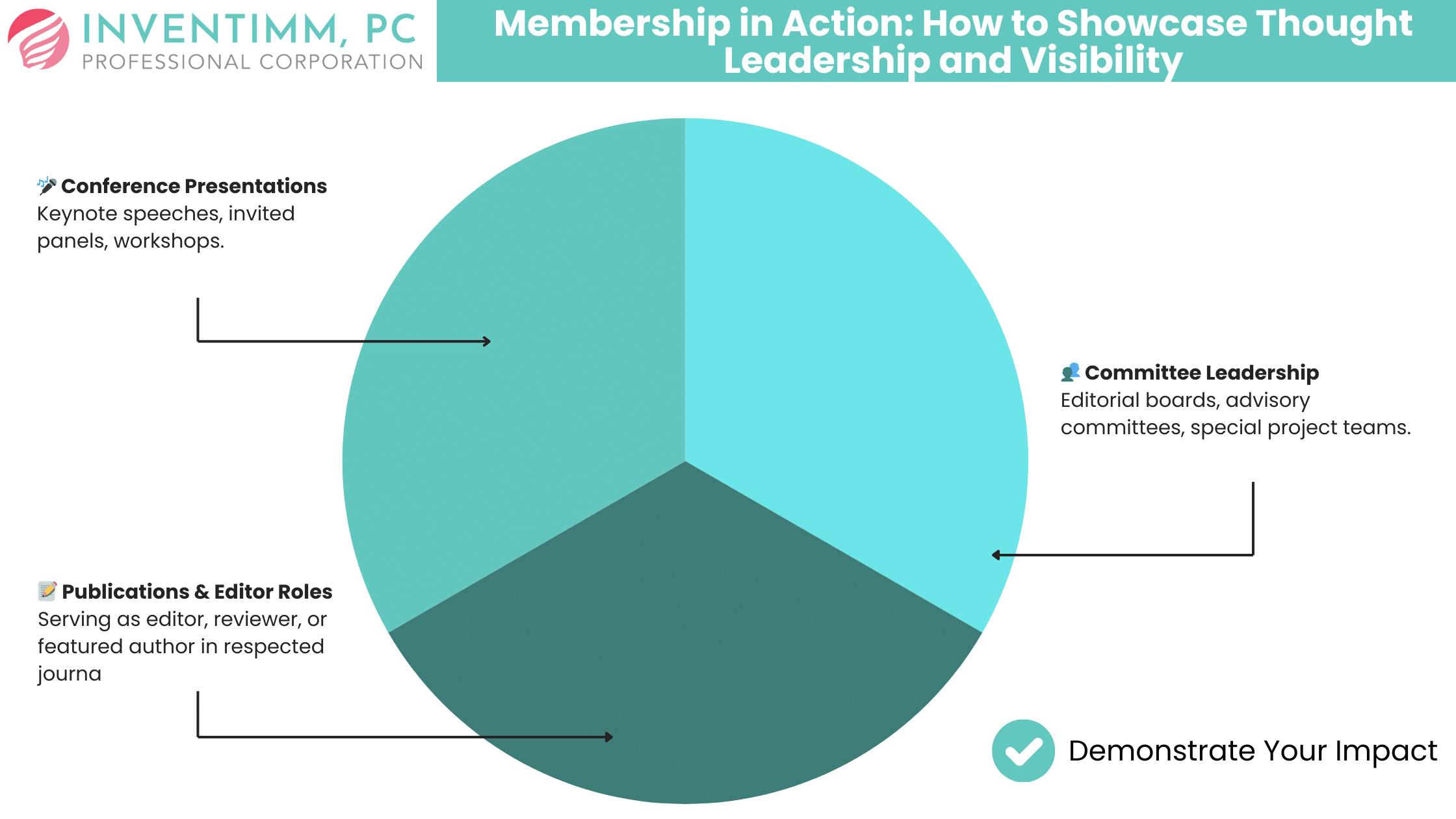
Being an active member—especially in committees or leadership teams—often results in tangible evidence of your influence and acclaim. Examples:
- Conference Presentations: If your association invites you to speak at high-level summits or organizes events where you’re the keynote, that proves your standing.
- Committee Work: When you serve on editorial boards, advisory committees, or special project teams within the association, it demonstrates recognition by peers.
- Publications or Editor Roles: If the association runs a journal or newsletter, your role as an editor, reviewer, or featured author can show how you’re shaping the conversation in your field.
All of these can be cross-referenced in your EB-1A petition to bolster multiple criteria, even if you do not rely on the membership criterion alone.
14. Strategizing Your EB-1A Filing: Combining Criteria
- Membership Plus a Leading or Critical Role
- If you cannot prove the membership is exclusive enough on its own, you might pivot and emphasize how you lead an important segment of that group.
- Examples: Chair of a standards-setting committee, program director for a high-visibility conference.
- Membership Plus Evidence of Original Contributions
- Show how your membership provided a forum for you to present or publish groundbreaking work, which the association widely recognized.
- If your membership led to a formal award or letter of recognition from the group, you can use that under the “Lesser Nationally or Internationally Recognized Prizes or Awards” criterion.
- Membership Plus Judging/Peer Review
- Demonstrate that your recognized expertise within this association resulted in your serving on review panels for the group’s journal or conferences.
- Provide emails, appointment letters, or official announcements confirming your role as a judge/reviewer.
- Membership and High Salary
- In rare cases, membership in an elite association might correlate with receiving a significantly higher compensation than peers, if you can document the direct link. This can be used for the “high salary” criterion, although it often requires robust wage comparison data.
Combining multiple criteria with membership activities can create a comprehensive narrative that you are consistently recognized for your extraordinary skill and leadership in the field.
15. Conclusion and Final Takeaways
Securing an EB-1A approval is challenging because USCIS looks for individuals who are truly at the pinnacle of their field. “Membership in associations requiring outstanding achievements” remains one of the most scrutinized criteria because of:
- Widespread misuse of generic or fee-based societies.
- Under-documentation of the selection process.
- Over-reliance on big-name organizations without explaining the specific membership tier or exclusivity.
That said, properly documented membership in a recognized, selective association can be extremely beneficial to your EB-1A petition. And importantly, even if your membership does not neatly fit the “membership criterion,” the tangible involvement—leadership positions, committee work, presenting at conferences, or judging roles—can strengthen your claim under other EB-1A criteria, such as:
- Leading or Critical Role in a Distinguished Organization
- Original Contributions of Major Significance
- Participation as a Judge of the Work of Others
- Published Material About Your Work (if the association’s publications have covered your contributions)
Final Suggestions
- Evidence Is King: Provide official and verifiable documentation of your membership status, selection criteria, and the exclusivity or prestige of the association.
- Explain Each Connection: Do not assume the adjudicator knows the significance of your organization. Spell it out with data, references, and third-party attestations.
- Consider Multiple Angles: If your membership cannot stand alone, highlight the activities—speaking engagements, committee leadership, editorial roles—that can support you under different EB-1A prongs.
- Stay Organized: Present your materials in a clear, logical format. Provide a well-structured index or cover letter that leads the examiner through your evidence step by step.
By combining strategic documentation of membership and active contributions within your professional associations, you create a more robust, multi-faceted EB-1A petition. This holistic approach acknowledges the strict requirements of the membership criterion while unlocking the potential for additional leadership and acclaim-related evidence, ultimately strengthening your case in the eyes of USCIS and the AAO.
Frequently Asked Questions (FAQ) About the EB-1A Membership Criterion
- What qualifies as a “membership in associations” for the EB-1A visa? To satisfy the EB-1A membership criterion, the association must require outstanding achievements from its members, as evaluated by recognized national or international experts in the field.
- Do associations with open membership policies meet the EB-1A membership criterion? No, associations that grant membership based solely on payment of dues or minimal qualifications do not meet the EB-1A standard. The association must have stringent membership requirements that recognize exceptional achievements.
- What evidence is needed to demonstrate that my membership meets the EB-1A criterion? You should provide documentation detailing the association’s membership criteria, evidence that these criteria require outstanding achievements, and proof that recognized experts evaluate applicants’ qualifications.
- Can membership in a trade union or provincial organization satisfy the EB-1A membership requirement? Generally, no. Memberships based on employment, standard credentials, or payment of dues without a focus on outstanding achievements do not satisfy this criterion.
- How can I strengthen my EB-1A petition if my memberships do not meet this criterion? If your memberships do not satisfy the EB-1A membership criterion, you can focus on other criteria, such as evidence of original contributions, authorship of scholarly articles, or participation as a judge of the work of others.
Disclaimer: This blog post is intended for general informational purposes only and does not constitute legal advice. Immigration laws and policies are complex and subject to change. Readers are strongly encouraged to consult a qualified immigration attorney for guidance tailored to their specific situation.
Not sure if you qualify for O-1A, O-1B, EB-2 NIW or EB-1A?
Fill the form and get FREE ASSESSMENT from our attorney or book 20min. introducing consultation.